
Pulse Control’s Role as a DELTA Supplier in the UAE and GCC

Pulse Control plays an important role as a DELTA supplier in the UAE and GCC countries, helping make DELTA’s automation, power electronics, and energy-efficient technologies more accessible to businesses across the region. With local distribution and technical support, Pulse Control helps customers get the right products along with the assistance needed for successful installation and operation.

Supporting Industrial Automation

Industrial automation is becoming increasingly important across the UAE and GCC as businesses look for smarter and more efficient ways to operate. Through its DELTA product range, Pulse Control supports manufacturers and industrial companies with automation solutions that can improve productivity, simplify processes, and enhance overall operational efficiency.

These solutions also support the region’s move toward smart manufacturing and more advanced production environments.

Supporting Renewable Energy and Sustainability

Renewable energy and sustainable development are major priorities across the GCC. Pulse Control supports these efforts by supplying DELTA power and energy-efficient products that can be used in applications related to solar energy, energy management, and green infrastructure.

By helping businesses use energy more efficiently, these solutions can contribute to lower energy consumption and support the region’s wider sustainability goals.

Telecommunications and Data Center Applications

The rapid growth of digital services, telecommunications, and data centers across the GCC has increased the need for reliable power and networking components. Pulse Control supplies DELTA technologies that can support these critical applications.

As businesses and governments continue investing in digital infrastructure, reliable networking and power solutions are becoming increasingly important for maintaining stable communication and data services.

Local Technical Support

One of the advantages of working with a local supplier is access to technical assistance and application guidance. Pulse Control supports customers with product selection, installation assistance, troubleshooting, and solutions tailored to specific requirements.

This local support can make it easier for businesses to integrate DELTA products into their existing systems and keep their equipment operating reliably.

DELTA Distribution Across the Middle East

Pulse Control supplies DELTA products across several Middle Eastern markets. The company serves as a DELTA dealer in Saudi Arabia and a DELTA dealer in Israel, while also supporting customers as a DELTA supplier in Israel, DELTA supplier in Egypt, DELTA supplier in Qatar, and DELTA supplier in Turkey.

Its product portfolio includes components such as inductors, transformers, RF inductors, power modules, and networking solutions, supporting a wide range of industrial and technology applications.

Why DELTA Products Are Relevant in the UAE and GCC

1. Telecommunications and Networking

The UAE, Saudi Arabia, Qatar, and other GCC countries are investing heavily in telecommunications and digital infrastructure. Networking components such as Ethernet transformers, filters, and RF inductors can support communication systems, wireless technologies, IoT applications, and other connected infrastructure.

These components help provide reliable signal transmission and support the growing demand for high-speed communication networks.

2. Renewable Energy and Power Management

Solar energy and other renewable energy projects are expanding across the region. DELTA power modules, inductors, transformers, and related components can support energy conversion, power management, and distribution applications.

Current sensing resistors and transformers can also be used for monitoring and controlling power flow, which becomes increasingly important as renewable energy is integrated into modern power systems.

3. Automotive and Electric Vehicles

Electric vehicle adoption is growing in countries such as the UAE and Saudi Arabia. This development is creating demand for reliable EV charging and power infrastructure.

DELTA inductors, transformers, and power modules can support power conversion and distribution applications within this growing sector. Products related to mechatronic systems and coil solutions can also support automotive applications as the industry moves toward electric and hybrid technologies.

4. Industrial Automation and Manufacturing

The GCC is working to strengthen manufacturing and reduce its dependence on traditional economic sectors. Automation and smart manufacturing are important parts of this development.

DELTA components such as solenoids, EMI filters, and power modules can support automated machinery, robotics, and industrial control systems. EMI filters can also help protect sensitive electronic equipment from unwanted electrical interference.

5. Defense and Aerospace

Defense and aerospace are important technology-driven sectors in countries such as the UAE and Saudi Arabia. Components including transformers, RF inductors, and power modules can support communication, electronic, and avionics-related applications where reliable performance is essential.

6. Energy-Efficient Buildings

Energy efficiency is becoming increasingly important in GCC construction and infrastructure projects. Modern buildings are adopting technologies designed to reduce energy consumption and improve overall system performance.

DELTA products and energy management technologies can support applications involving HVAC systems, power management, and other building infrastructure. These solutions can contribute to more efficient and sustainable buildings.

7. Smart Cities and IoT

Smart city development is expanding across the GCC, with connected systems being used for transportation, energy management, communication, and public infrastructure.

DELTA networking products, EMI filters, and power modules can support the underlying infrastructure required for connected devices, IoT systems, smart grids, and real-time data applications.

Conclusion

DELTA’s broad range of products, from inductors and transformers to RF components, power modules, and networking solutions, can support many of the industries driving development across the UAE and GCC.

Through its role as a DELTA supplier, Pulse Control helps businesses access these technologies along with local technical support and application guidance. As the region continues to invest in automation, renewable energy, digital infrastructure, EVs, and smart cities, reliable and energy-efficient technologies will remain an important part of this growth.

Delta Automation Solutions for Every Industry

Pulse Control provides Delta automation solutions designed to support the different needs of businesses across various industries.

  • Manufacturing: Improve production processes with advanced automation and motion control solutions.
  • Energy & Utilities: Support efficient operations with smart power solutions and renewable energy technologies.
  • Infrastructure & Construction: Improve building automation, HVAC control, and power management.
  • Logistics & Warehousing: Make material handling more efficient with conveyor automation and robotics systems.

Enhance Your Business with Delta & Pulse Control

With Pulse Control, businesses across the UAE and GCC can access reliable Delta automation solutions designed for better performance and efficiency. Whether you need customized automation systems or dependable power solutions, Pulse Control can provide solutions suited to your application.

Get in touch with Pulse Control today and explore how Delta solutions can support your business.

Why choose Delta products from Pulse Control?

Delta is a globally recognized brand known for energy efficiency, reliability, and advanced automation. Pulse Control ensures genuine Delta products, technical support, warranty coverage, and fast delivery across the UAE and African markets.

Can DELTA products be used for industrial automation?

Yes, DELTA products are commonly used for motor control, factory automation, conveyors, pumps, HVAC systems, and other industrial applications.

How do I choose the right DELTA product?

The right product depends on your application, motor capacity, voltage, load requirements, and control needs. A DELTA supplier can help you select a suitable option.

What DELTA products are commonly available?

Common products include VFDs, inverters, HMIs, PLCs, servo systems, and automation components.

Can DELTA products help reduce energy consumption?

Yes, products such as DELTA VFDs can help improve motor efficiency by adjusting motor speed according to the actual operating requirements.

Can DELTA products be customized for different applications?

The suitable DELTA model can be selected based on the specific application, motor requirements, and system configuration.

Where can I buy DELTA products?

You can purchase DELTA products through an authorized DELTA supplier or dealer, who can also assist with product selection and technical support.
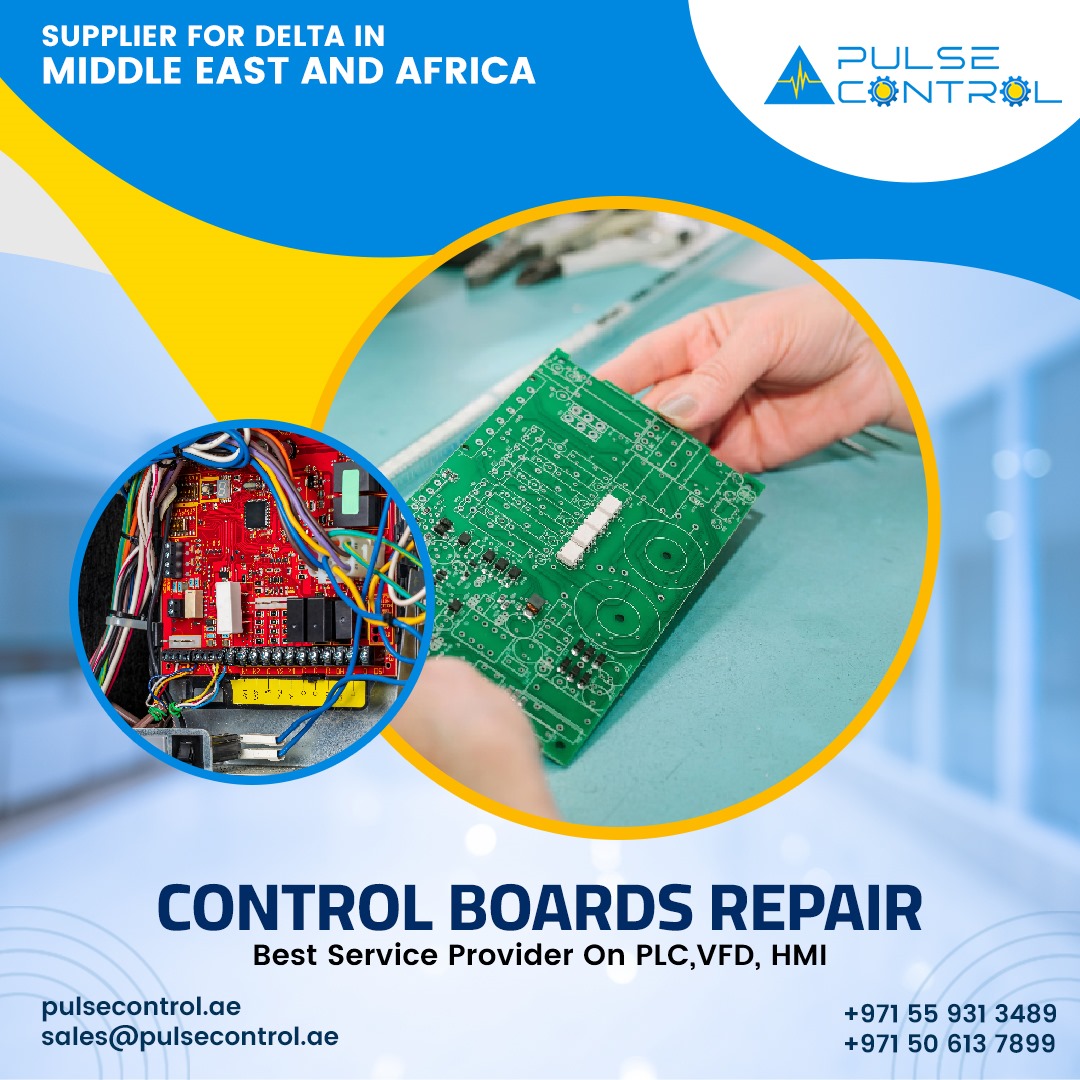
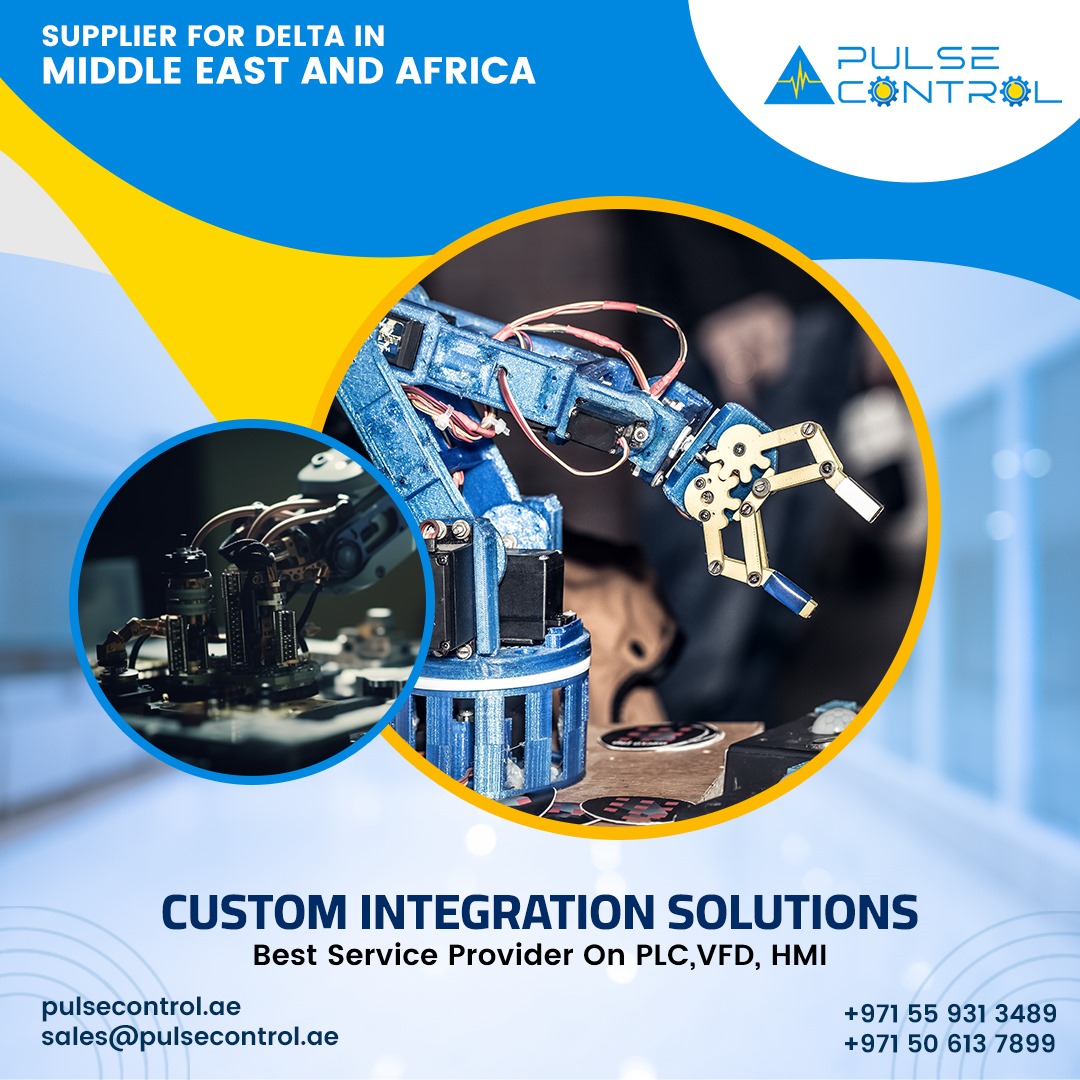
 

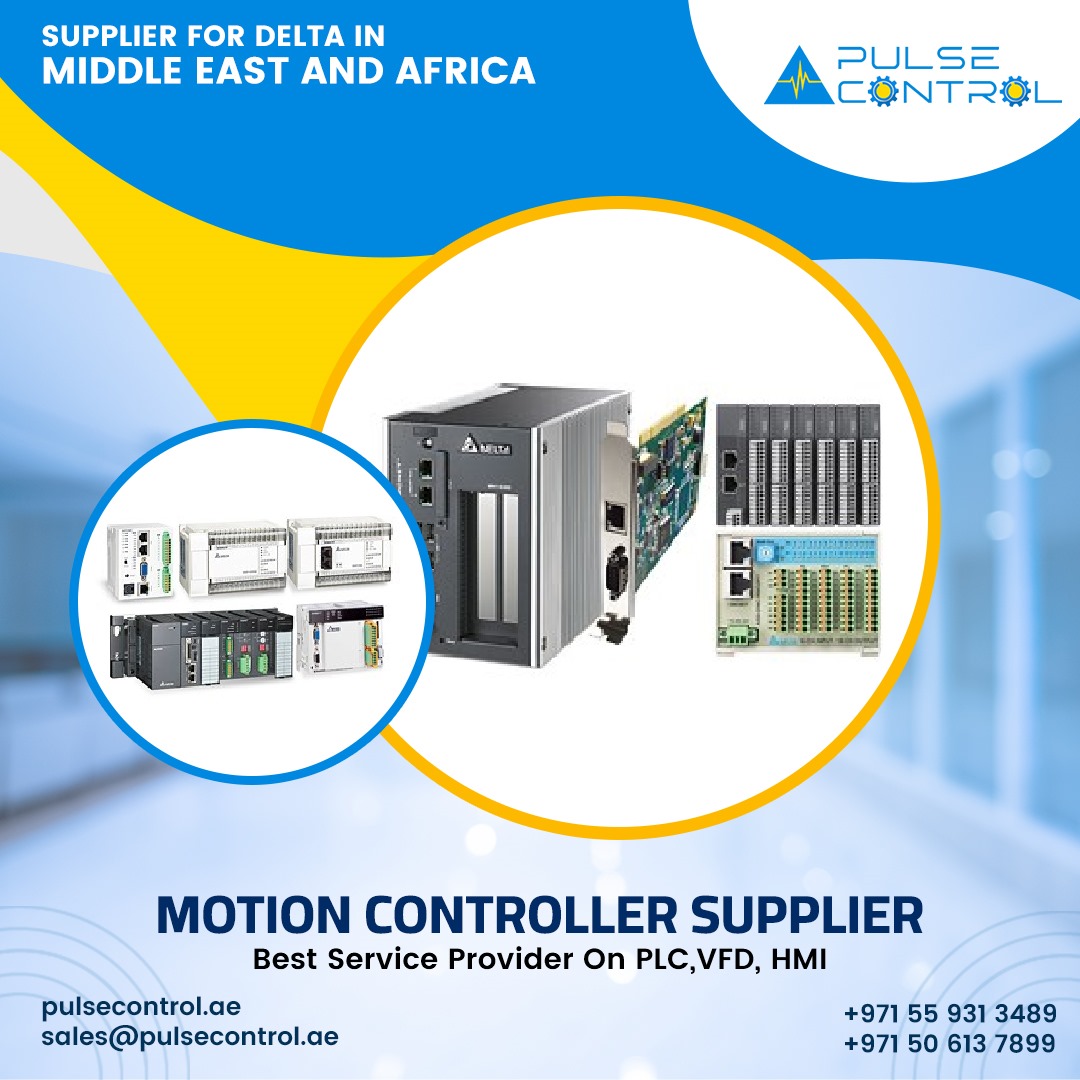
Pulse Control Is the Only Way Products UAE and MENA region. As one of the well-known DELTA dealer in UAE, DELTA dealer in Abu Dhabi, DELTA dealer in Dubai, DELTA dealer in Sharjah, and DELTA dealer in Umm Al Quwain, Pulse Control is committed to providing superior DELTA automation solutions for diverse industries. Our comprehensive network extends throughout the region, establishing us as a dependable DELTA dealer in Africa, DELTA dealer in Bahrain, and DELTA dealer in Egypt. In addition, we proudly operate as a professional DELTA supplier in Israel, DELTA supplier in Iraq, DELTA supplier in Egypt, DELTA supplier in Turkey, and DELTA supplier in Palestine, offering advanced PLC, HMI, VFD, and comprehensive automation solutions to meet every industrial requirement. * DELTA dealer in Sharjah * DELTA dealer in Ajman * DELTA dealer in Umm Al Quwain * DELTA dealer in Fujairah * DELTA dealer in Africa * DELTA dealer in Iran * DELTA dealer in Yemen * DELTA supplier in Fujairah * DELTA supplier in Africa Pulse Control: Automation Solution Provider UAE and GCC Pulse Control is a leading supplier in the UAE and GCC region, offering a diverse range of industrial automation products and solutions. Our comprehensive portfolio includes power supplies, VFDs (Variable Frequency Drives), PLCs (Programmable Logic Controllers), HMIs (Human-Machine Interfaces), and more, designed to cater to the specific needs of various industries such as manufacturing, oil and gas, water and wastewater treatment, and infrastructure. With a strong focus on quality, reliability, and cutting-edge technology, Pulse Control empowers businesses with efficient and innovative solutions to optimize operations and enhance productivity. As your trusted automation partner in the UAE and GCC, we are dedicated to supporting your growth with our expertise and comprehensive product offerings. The induction coil (often simply called a coil, or more specifically an inductor) is a component of electric circuit, store energy to magnetic field when electrical current flows through it. An inductor is constructed from insulated conduction wire, usually a conducting helix to form a coil. So it will store the magnetic energy to electromagnetic field through electric circuit. Inductors: Inductors are passive electrical component used for storing electrical energy in form of magnetic field. They primarily are consists of conductor coil, wound around a core. These cores are usuallymade of the magnetic materials like ferrite, iron or iron powder for enhancing the inductance. Key functions and applications of inductors: Transformers: They form key functional elements in electrical devices like a transformer that transfer the electrical energy from one electrical circuit to other or transfer signal from the signals by induction. Chokes Coils: Aninductor in an electrical circuitthat impedeshigherfrequency alternating currentswhilepermittingLower frequency ones to pass is termed as choke. They is widely used asFilters in signal electronicscircuitries forisolationsbetween higherandlower frequency components. Frequency selective Tuners: They is used in the tuning circuits for selectionoffrequency range; e.g., radios use tuning circuit comprising of inductors, capacitors and resistor. Oscillatorcircuit: they also participate as a fundamental componentsin the formation of tunable oscillators and also in RF frequency generation. Inductance values for electric circuit usually range from mH to H (micro Henries to Henries) to ensure that they offer the inductance needed for their designed circuits. Inductors used are broadly classified into air core inductors, ferrite and iron cores inductors, variable inductors. This type of inductors is commonly and widely used as filtering circuit device, it will prevent unwanted voltage of higher level frequencies while allowing low levels of frequencies and current to passing to the circuitry components. For more information on ourproducts/servicescontactPulse Control! Pulse Control specializes in supplying advanced automation and control solutions across the UAE and the wider GCC region. As a premier DELTA dealer in UAE, DELTA dealer in Abu Dhabi, DELTA dealer in Dubai, DELTA dealer in Sharjah, and DELTA dealer in Umm Al Quwain, we provide a comprehensive range of DELTA products including PLCs, HMIs, VFDs, and other industrial automation components. Our commitment extends beyond local borders, establishing us as a reliable DELTA dealer in Africa, DELTA dealer in Bahrain, and DELTA dealer in Egypt, alongside being a trusted DELTA supplier in Israel, DELTA supplier in Iraq, DELTA supplier in Egypt, DELTA supplier in Turkey, and DELTA supplier in Palestine. Pulse Control is your gateway to cutting-edge automation technology, designed to enhance efficiency and productivity in industries like manufacturing, energy, water, and more. *s an expert dealer in Abu Dhabi, Dubai, Sharjah, and Umm Al Quwain, we are dedicated to providing cutting-edge products, including PLCs, HMIs, and VFDs, that enhance operational efficiency. Our reach extends globally as a reliable dealer and supplier in Africa, Bahrain, Egypt, Israel, Iraq, Turkey, and Palestine, delivering high-quality automation products and exceptional technical support. With Pulse Control, you gain access to innovation, reliability, and tailored automation strategies for your business. The term 'industrial automation' defines the method by which industrial processes, jobs, and other tasks are performed automatically using control systems, hardware (machinery), computers, and software. Modern industrial automation, powered by computer and information technologies along with devices and technologies like AI and robotics, minimizes human labor, effort, cost, precision and ensures more reliable performance with far less output. All industry segments are utilizing this approach. Examples include automotive automation systems in manufacturing and automation in health care, for managing the process, for making a device that is used in automation for health-care, such as ventilators etc . Some other industry applications include oil and gas facilities, mining, and food and beverage production, just to name a few. This approach is known to help companies achieve much higher levels of quality, increased speed and output efficiency with increased safety standards, as well as reduced prices to their consumers.Here’s the breakdown of a transformer: Key Components: Primary Winding: The coil of wire that accepts electrical energy from an external source. When an alternating current (AC) flows through this coil, a magnetic field is generated. Secondary Winding: The coil of wire where electrical energy is induced and sent out to an external load. The magnitude of the induced voltage is related to the ratio of the number of turns on the primary winding to the number of turns on the secondary winding. Magnetic Core: Made of iron or other magnetic materials, this structure provides a path for the magnetic flux to link between the primary and secondary windings, enhancing the transformer's efficiency. Operating Principle: Transformers operate based on Faraday's Law of Electromagnetic Induction. This principle states that a changing magnetic field in one coil can induce an electromotive force (EMF) in a nearby second coil. When AC current is applied to the primary winding, it produces a fluctuating magnetic field in the core. This fluctuating magnetic field then cuts across the turns of the secondary winding and induces a changing voltage in it. By adjusting the number of turns on the primary and secondary windings, the output voltage can be either increased (stepped up) or decreased (stepped down) relative to the input voltage. Types of Transformers: Step-Up Transformer: These transformers increase the voltage from the primary side to the secondary side. They are essential for transmitting electricity over long distances at high voltages to minimize energy loss. Step-Down Transformer: These transformers decrease the voltage from the primary side to the secondary side. They are used to reduce high voltages from the power grid to lower, safer levels for use in homes and businesses. Isolation Transformer: An isolation transformer transfers energy between two electrical circuits through electromagnetic induction, but electrically isolates the two circuits. It doesn't usually change voltage, but provides electrical isolation for safety purposes, or to reduce common-mode noise in sensitive electronic equipment. Autotransformer: A type of transformer having a single winding with one or more Taps, which allows an option of changing the output voltage. They are generally smaller and more efficient than their conventional counterparts, but they do not provide isolation between primary and secondary circuits. Three-Phase Transformer: These transformers are used in power systems and are typically larger to accommodate the higher power demands of industrial applications, which commonly use three-phase power. They can be designed as either step-up or step-down transformers. Applications: Power Transmission and Distribution: Step-up transformers at power generation stations boost voltage for efficient long-distance transmission, and step-down transformers in substations lower voltage for distribution to consumers. Electronics and Appliances: Small transformers are used in power supplies of electronic devices, such as computers, TVs, and charging adapters, to convert high voltages into lower ones required by circuits. Industrial Equipment: Used in a wide variety of industrial machinery, process control, and manufacturing equipment to step up or step down voltage to meet specific operational needs. Renewable Energy Systems: In solar and wind farms, step-up transformers increase the generated electricity to higher voltages for integration into the main grid, while step-down transformers might be used for local consumption. Key Concepts: Turns Ratio: This is the ratio of the number of turns in the primary winding to the number of turns in the secondary winding (Np/Ns). It directly determines the factor by which the voltage will be stepped up or stepped down. Efficiency: Transformers are highly efficient (typically above 95%), with energy losses mainly occurring due to magnetic hysteresis in the core, eddy currents induced in the core and conductors, and resistance of the winding materials. Impedance Matching: Transformers are also used in communication systems to match the impedance of different circuits (e.g., a transmitter to an antenna, or audio amplifier output to a speaker) to ensure maximum power transfer and minimize signal reflections. In essence, transformers are fundamental devices for efficiently and safely manipulating AC voltages in a wide range of applications. Let me know if you’d like more details on a specific aspect of transformers! Networking is the process of connecting multiple electronic devices and systems so that they can exchange data, share resources, and communicate with each other. This interconnection forms the basis for modern information technology and is crucial for everything from small home networks to the global internet. Here are some of the core concepts: Network Types: Local Area Network (LAN): Connects devices within a limited geographic area, like an office building, school, or home. Ethernet is a common LAN technology. Wide Area Network (WAN): A network that spans a broad geographical region, connecting multiple LANs together. The Internet is the most extensive WAN. Metropolitan Area Network (MAN): Typically covers a city or a large urban area, serving as a large LAN or a small WAN. Personal Area Network (PAN): Connects devices over a very short range, such as between a smartphone and a Bluetooth headset. Network Topologies: The arrangement of network elements is called a topology. Some common topologies include: Bus Topology: All devices are connected to a single communication line. Simple but prone to congestion. Star Topology: All devices are connected to a central hub or switch. Easy to manage and troubleshoot. Ring Topology: Devices are connected in a circle, with data passing from one device to the next. Mesh Topology: Every device is connected to every other device, providing high redundancy but is costly to implement. Network Protocols: These are sets of rules that govern how devices communicate on a network. The most fundamental protocol suite for the Internet is TCP/IP (Transmission Control Protocol/Internet Protocol), which includes various other protocols such as: HTTP/HTTPS: Used for web browsing. FTP: Used for file transfer. DNS: Used to translate domain names into IP addresses. SMTP/POP3/IMAP: Used for sending and receiving emails. IP Addressing: Each device on a network is assigned a unique identifier called an IP address. This can be a 32-bit IPv4 address (e.g., 192.168.1.100) or a 128-bit IPv6 address (e.g., 2001:0db8::1). Devices can have either a public IP address (reachable from the internet) or a private IP address (used within a local network). Networking Devices: Router: Directs data packets between different networks. Connects your home network to the internet, for example. Switch: Connects devices within a LAN and manages the flow of data between them, efficiently handling traffic. Modem: Converts digital signals from your computer into analog signals that can be transmitted over telephone lines or cable, and vice versa. Firewall: A security barrier that monitors and controls incoming and outgoing network traffic according to predefined rules, protecting your network from unauthorized access. Wireless Networking (Wi-Fi): A method for devices to connect to a network wirelessly using radio waves, based on IEEE 802.11 standards. Cellular Networks: Wireless networks used for mobile devices (e.g., 4G, 5G) which provide WAN connectivity. Network Security: Measures taken to protect data and devices on a network from unauthorized access, damage, or theft. This includes: Encryption: Scrambling data so it can only be read by authorized parties. VPNs (Virtual Private Networks): Creating secure, encrypted connections over less secure networks. Firewalls: Filtering malicious traffic. Intrusion Detection/Prevention Systems (IDS/IPS): Monitoring for and responding to suspicious activity. Authentication and Authorization: Ensuring the identity of users and granting appropriate access levels. Cloud Networking: Utilizing network resources, such as servers and storage, hosted in a data center remotely accessible via the internet. This offers scalability and flexibility. Importance of Networking: Communication: Enables instant messaging, emails, voice calls, and video conferencing. Resource Sharing: Allows multiple users to share files, printers, internet access, and software. Data Management: Facilitates centralized storage, backup, and access to data. Business Operations: Supports collaboration, customer relationship management, and online commerce. Networking is fundamental to almost every aspect of our digital lives, enabling the flow of information that powers the modern world. Let me know if you'd like to dive deeper into any of these topics!

What Services Are Included in DELTA Automation Solutions?

Service TypeDescriptionKey Benefits
DELTA Product SupplySupply of DELTA PLC, HMI, VFD, and automation componentsReliable performance, advanced automation
System IntegrationIntegration of DELTA systems with industrial processesImproved efficiency, seamless operation
Technical SupportInstallation, troubleshooting, and maintenance servicesReduced downtime, long-term reliability

Leave a Reply

Your email address will not be published. Required fields are marked *

Comments

  1. We had a great experience with Pulse Control. The DELTA products were supplied on time, and the team was very helpful with product selection and technical support. The equipment has been performing reliably, and we are very happy with the overall service. Highly recommended!
About Us

Our services include Detail Engineering solutions, Machine Automation, Process Automation, Control Panel Design & Assembly, PLC Programming, VFD Installation & Commissioning, Energy Monitoring Solutions, Products Supply and support on industry leading brands.

Networks

Products

  • Programmable Logic Controller
  • Variable Frequency Drive
  • Servo Motor & Drive
  • Motion Controller
  • Scada
  • More...

Services

  • Level Monitoring System
  • Pneumatic & Hydraulics
  • Industrial Automation
  • Control Panel Designing
  • Wiring Solutions
  • More...

Our Address

Pulse Control Industrial
Equipment’s Trading LLC
Al Qusais Industrial Area-1,
Dubai-UAE.
Tel.: +971-55-9313489
+971-55-9520689
Email :  sales@pulsecontrol.ae , service@pulsecontrol.ae

© 2022 Welcome to Pulse Control. All rights reserved

Privacy Preference Center